

The Lionfish Invasion in the Caribbean: A Beautiful Threat to Coral Reefs

Updated: Jul 3

How lionfish spread across the Caribbean, why they’re impacting reefs, and how divers can help control the invasion.
Impacts of Invasive Lionfish
Diving in the Caribbean is always incredible—the water, the colours, the feeling that everything is alive around you. Imagine your first dive here, hovering at about 12 metres (40 ft), just watching the reef, when something catches your eye. You see something mesmerising and so elegant. Delicate fins spread like lace, and a slow, quiet arrogance that shows it’s not afraid of you. It’s almost hypnotic to watch.
This is when you notice that it’s not moving like the others. No sudden darting or nervous energy so prevalent in the other life around you. Just a confidence that is completely unbothered by your presence.
It looks out of place. Then maybe you realise that what you are actually seeing is one of the most successful invasive predators the Caribbean has ever seen.
At first glance, you feel privileged to see something so beautiful—but that feeling shifts as you begin to understand what it is actually doing to the delicate balance of the reef beneath you.
Lionfish have become a symbol of the invasive species problem across the western North Atlantic. You’ll often hear them compared to other well-known invaders like zebra mussels, snakeheads, and Asian carp—but underwater, the impact feels much more immediate.
Their numbers continue to grow, putting real pressure on coral reefs and the marine life that depends on them, including fish that support both local livelihoods and tourism. There’s a lot of work being done to try to control their spread, but it remains an ongoing challenge.
History

The name “lionfish” actually refers to two closely related species that are almost impossible to tell apart. Both are native to the Indo-Pacific, where they naturally live on coral reefs across a huge range—from Australia and Malaysia to Japan, Polynesia, and beyond.
They were first recorded off the coast of Florida in the mid-1980s. It’s widely believed that aquarium releases—either accidental or intentional—played a key role in their introduction. Lionfish are popular in home aquariums, and multiple releases over time likely allowed them to establish a foothold in the Atlantic.
By the early 2000s, they were no longer just sightings—they were established.
From there, the spread was fast.
Lionfish now inhabit reefs, wrecks, mangroves, seagrass beds, and even estuarine environments throughout the western Atlantic, Caribbean, and Gulf. They’ve been recorded from very shallow water down to around 90 metres (300 ft), making almost every warm-water habitat vulnerable.
And they’re still expanding. Their populations have grown rapidly over the past 15–20 years, and in many areas, scientists believe they haven’t yet reached their peak. That means continued pressure on native reef ecosystems, as lionfish consume large numbers of small fish—including species that are critical for reef health and local fisheries.
What makes this invasion particularly challenging is how adaptable they are. Recent research shows they can even tolerate brackish water, putting mangroves and estuaries—key nursery habitats—at risk as well.
How Did Lionfish Get to the Caribbean?
The Theories
As mentioned, lionfish are native to the Indo-Pacific, including the Pacific and Indian Oceans and the Red Sea. So how did they end up in the Atlantic?
The most widely accepted explanation is aquarium release. Lionfish are popular in the pet trade, and it’s believed that multiple individuals were either intentionally released or accidentally introduced off the coast of Florida.
There’s also a commonly referenced event tied to Hurricane Andrew in 1992, which destroyed coastal infrastructure, including aquariums. Some reports suggest this may have contributed to early releases, although there are no confirmed records.
Another theory, seen with other marine invasive species, involves ballast water from ships. Vessels take on water for stability and later release it in different regions, sometimes transporting organisms across oceans. (This is now regulated under international maritime conventions.)

Key Timeline of the Invasion
1980s – First Introduction The earliest lionfish are believed to have been released off Florida. These were likely isolated events, but enough to begin establishing a population.
1992 – Possible Acceleration: Hurricane Andrew may have contributed to additional releases, increasing the number of individuals in the wild.
Mid-1990s – Establishment Begins: Small populations start to take hold along the Florida coastline.
2000–2004 – Rapid Expansion: Lionfish spread along the U.S. East Coast and into the Bahamas. In 2004, a lionfish was recorded near New Providence Island. By 2005, they had already been reported in 16 locations across the Bahamas.
By ~2007, Caribbean Invasion Lionfish were widely established across the Caribbean, including Mexico, Belize, and Honduras.
By ~2010 – Full Regional Spread. They had spread throughout nearly the entire Caribbean basin and Gulf.

Where They Are Now
Today, lionfish range from New York all the way down to South America, including the Gulf and Brazil.
What’s most striking is the speed of it all—they established themselves across most of the Caribbean in less than a decade.
What is a Lionfish?

The Lionfish
Lionfish belong to the scorpionfish family (Scorpaenidae), within the genus Pterois. Two species are responsible for the invasion in the Atlantic: Pterois volitans and Pterois miles. You might also hear them called zebrafish or turkeyfish.
They’re instantly recognisable—long, flowing fins and bold stripes—but they’re also equipped with 18 venomous spines, used purely for defence.
These include:
13 dorsal spines
3 anal spines
1 pelvic spine on each side
Despite how dramatic they look, lionfish move slowly and deliberately, using the soft rays of their fins to glide through the water. They’re often described as nocturnal hunters, but in the Atlantic they are frequently active during the day, either alone or in small groups.
During daylight hours, they may shelter under ledges or within reef structures—but just as often, you’ll see them out in the open, completely unfazed by divers.
Habitat & Adaptability
Lionfish are incredibly adaptable, which is one of the reasons they’ve been so successful.
They can be found in almost every marine habitat
Coral reef
Mangrove
Seagrass bed
Lagoons and sand patches
Artificial structures like wrecks

They occupy a wide depth range—from very shallow water down to over 300 metres (984 ft)—and can tolerate temperatures from around 12.5°C to 39°C (54.5°F to 102°F).
They are also territorial and may remain in the same area for up to seven months.
Around Isla Mujeres, lionfish are commonly found on the many shipwrecks that surround the island. While numbers vary depending on recent removal efforts, it’s not unusual to encounter multiple individuals on a single wreck dive—making these sites both a hotspot for sightings and an important focus for control efforts.
Reproduction & Growth
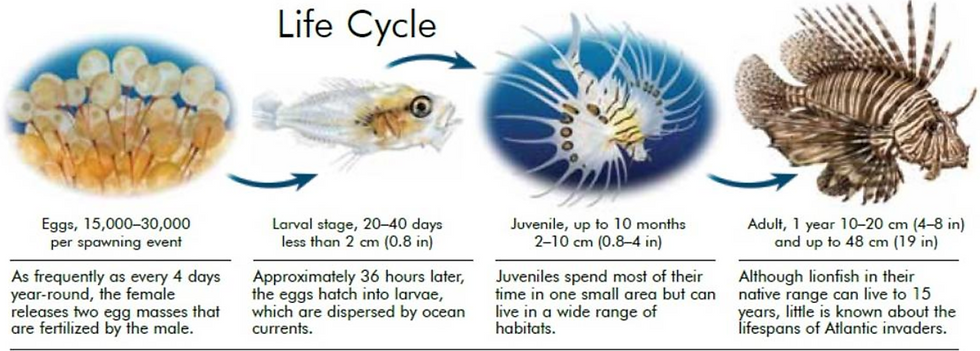
Lionfish grow quickly, reaching maturity in less than a year and living around 5–10 years. Once mature, they reproduce at an extraordinary rate.
They spawn in pairs
Reproduction happens year-round in the Atlantic
Spawning can occur every 2–4 days
Females release around 30,000 eggs at a time
One female can produce over 2 million eggs per year
These eggs are carried by ocean currents, allowing lionfish to spread rapidly across huge areas.
A Small Detail That Matters
Lionfish have cycloid scales—smooth, overlapping scales that give them greater flexibility compared to many other fish species.
In this type of scale, the anterior part of each scale is overlapped by the posterior portion of the scale in front of it, giving the fish greater flexibility than fishes with other types of scales. There are five main kinds of scales (placoid, cosmoid, cycloid, ctenoid, and ganoid).

Ecological Role
Lionfish are slow-moving and highly conspicuous, so they rely on their unusual colouration and extended fins to discourage potential predators.
In the Atlantic, they have become one of the top predators in many coral reef environments.
They consume over 50 species of fish, including many that are economically and ecologically important.
Lionfish are active hunters that ambush their prey by using their outstretched, fan-like pectoral fins to slowly pursue and corner them.
Why Did They Become a Problem So Fast?
The Incredibly Efficient Predators
Lionfish are incredibly efficient predators—and in the Caribbean, nothing is keeping them in check.
They have no natural predators here, and combined with rapid reproduction, their populations have exploded. The result is a predator that eats almost anything, almost constantly, with very little resistance from the ecosystem, having a detrimental effect on the balance of the food chain.
Lionfish are generalist carnivores, feeding on over 70 species of fish as well as many invertebrates. They’re capable of eating prey up to half their own body length, and studies show their diet is roughly 70% fish and 30% crustaceans.
They’re not selective.
They’ve been found consuming basslets, gobies, cleaner fish, shrimp, crabs, juvenile groupers—even jawfish still carrying eggs. Cannibalism has also been observed.
Lionfish will continue feeding until prey is depleted. Their stomach can expand up to 30 times its normal size, and one recorded individual—just 25 cm long—was found with 21 fish in its stomach. They can also survive for up to 12 weeks without food.
Impact on Caribbean Reefs
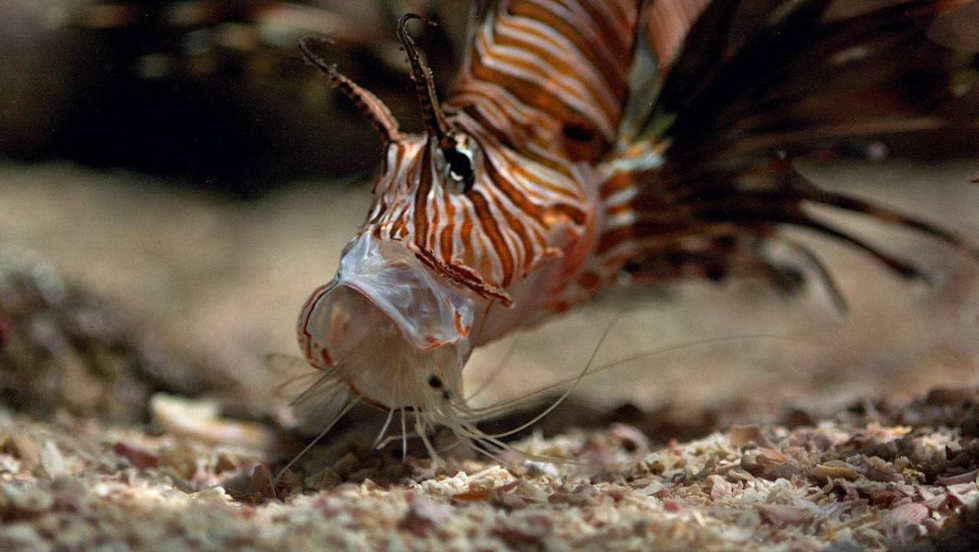
The impact is immediate—and severe.
Lionfish prey on commercially, recreationally, and ecologically important species, including fish that support local fisheries.
Dense populations can consume over 460,000 prey fish per acre per year
In heavily invaded areas, prey fish populations have dropped by up to 90%
A 2008 study recorded a 79% decline in juvenile fish on affected reefs
Lionfish feed on species normally eaten by larger predators like groupers and snappers, which can disrupt local fisheries. They also target herbivorous fish—the ones responsible for grazing algae off coral reefs.
Without these herbivores, algae grow unchecked, which can be detrimental to the health of coral reefs.
This creates a ripple effect:
Fewer herbivores → more algae
More algae → weaker coral
Weaker coral → less habitat for marine life
Lionfish are now expanding into mangroves and seagrass beds—critical nursery habitats—putting the next generation at risk before they even reach the reef.
These ecosystems are already under pressure from climate change, pollution, disease, overfishing, and sedimentation. Lionfish are adding another layer of stress to an already fragile system.
The Bigger Picture
Because they eat so widely, reproduce so quickly, and face no natural control, lionfish disrupt the entire reef system.
They reduce populations of key species that keep reefs healthy, impact fisheries that communities rely on, and ultimately affect tourism and the long-term resilience of coral ecosystems.
This has led to the listing of seven coral species in the Endangered Species Act (ESA) in the lionfish-infested area.
What Role Do Lionfish Play in Isla Mujeres’ Marine Ecosystem?
Isla Mujeres and its Lionfish
Lionfish began appearing in the waters around Isla Mujeres in the early 2000s and are now a common sight across many dive sites.
They can be found on reefs, wrecks, and even in shallower areas such as the Manchones Reef and our world famous MUSA. While densities vary, encountering lionfish is now a normal part of diving here.
Around the island’s many shipwrecks in particular, lionfish are often seen sheltering within the structure. These sites provide ideal habitat, and while regular removal efforts help keep numbers down, it’s still common to encounter multiple individuals on a single dive.
But it also means divers have a unique opportunity—not just to observe, but to actively help control their influence.
Unlike many conservation challenges, this is one where action is immediate and measurable. Removing even a single lionfish reduces pressure on the reef and protects countless smaller fish that play a critical role in maintaining reef health.
That’s where our Reef Defender: Lionfish Management Specialty Dive comes in.
This experience is designed to go beyond a typical dive. You’ll learn about lionfish behaviour, their negative effect on the reef, and how controlled removal efforts are carried out safely and responsibly. Depending on conditions and certification level, divers may also have the opportunity to assist in removal efforts under supervision.
It’s diving with purpose—where every dive contributes directly to protecting the reef. It’s also fun and one of our most popular specialties. Not to mention, you might even get to try some fresh lionfish ceviche on the way back to shore.
What Can Divers Do About Lionfish?
The Shift
This is where things shift—from problem to action.
Beyond individual dives, consistent local efforts are essential.
Local removal efforts play an important role in reducing lionfish populations and easing pressure on reef ecosystems. Removing lionfish from key sites helps reduce pressure on native species and supports the long-term health of coral reefs and local fisheries.
In most conservation challenges, it’s hard to feel like you can make a direct change.
With lionfish, you can.
Divers have effectively become the primary predator in this ecosystem—and that role matters. Every lionfish removed is immediate relief for the reef.
Ready to do more than just observe?
Join one of our Reef Defender: Lionfish Management Specialty Dives and take part in protecting the reef. From learning safe removal techniques to understanding the ecosystem, it’s diving with purpose.
How You Can Help
Join lionfish hunting dives. Spearfishing lionfish is one of the most effective ways to control their numbers.
Keep dive sites as clear as possible. Regular removal makes a measurable difference over time.
Report sightings. Support monitoring efforts by sharing sightings with local conservation groups, marine parks, or research initiatives where available.
Support local conservation initiatives. Many programs rely on divers to assist with monitoring and removal.
Educate and spread awareness. The more people understand the issue, the stronger the response.
Monitoring & Reporting Lionfish
Why Monitoring Matters
Removing lionfish is only one part of effective invasive species management. Equally important is understanding where lionfish are found, how many are present, and how their populations change over time. This information allows scientists, marine park managers, dive operators, and conservation organisations to evaluate the effectiveness of removal programmes and identify areas that require additional attention.
Every lionfish sighting contributes valuable information. Even if no lionfish are removed, recording their location and abundance helps build a clearer picture of the invasion and supports long-term conservation efforts.
As divers, we have a unique advantage. We spend time underwater in places that researchers cannot visit every day. By accurately observing and reporting what we see, we become an important part of protecting the reefs we enjoy diving.
Citizen Science in Action
Citizen science is the collection of scientific information by members of the public. Around the world, recreational divers make valuable contributions to marine conservation by recording observations of marine life, coral health, marine debris, and invasive species.
Lionfish monitoring is one of the most successful examples of citizen science in the Caribbean. Thousands of observations submitted by divers have helped researchers better understand the spread of lionfish, identify priority management areas, and measure the success of local removal programmes.
Every diver can make a meaningful contribution by collecting accurate information and reporting it responsibly.
What Should Be Recorded?
Whenever lionfish are observed during a dive, divers should record as much information as possible. The more complete and accurate the information, the more useful it becomes.
Useful information includes:
Dive site
Date
Time
Maximum depth
Approximate location on the reef or wreck
Number of lionfish observed
Estimated size (small, medium, or large)
Habitat type (reef, wreck, seagrass, mangrove, artificial structure)
Behaviour (resting, hunting, sheltering, swimming)
Number removed (if applicable)
Additional observations
Even when no lionfish are seen, recording a zero observation is valuable. It helps demonstrate where removal efforts are succeeding and where continued monitoring is needed.
Estimating Lionfish Size
Divers are not expected to measure lionfish underwater. Instead, they should estimate the size using simple categories.
For example:
Small: Less than 15 cm (6 in)
Medium: 15–25 cm (6–10 in)
Large: Greater than 25 cm (10 in)
These estimates help indicate whether an area contains mostly juveniles, breeding adults, or a mixture of both.
Identifying Priority Sites
Not every lionfish sighting requires immediate removal. Divers should consider factors such as:
Number of lionfish present
Size of the individuals
Sensitive reef habitat
Presence of juvenile reef fish
Frequency of previous removals
Local management priorities
This information helps conservation teams decide where future removal efforts will have the greatest benefit.
Reporting Your Observations

Monitoring only becomes valuable when observations are shared.
Divers should report lionfish sightings through local conservation programmes, marine park authorities, dive centres, or other approved monitoring initiatives operating in their region.
At Pocna Dive Center, students complete a Reef Defender Lionfish Survey after each training dive. These records contribute to our ongoing understanding of lionfish populations around Isla Mujeres and help guide future conservation activities.
Every Dive Makes a Difference
One lionfish may consume thousands of juvenile reef fish during its lifetime, but one well-documented sighting can also contribute to protecting an entire reef.
Whether you locate one lionfish, ten lionfish, or none at all, every observation improves our understanding of this invasive species and supports better management decisions.
As a Reef Defender, your role extends beyond removing lionfish. You are helping monitor the health of the reef, contributing valuable scientific information, and supporting long-term conservation efforts that benefit both marine life and future generations of divers.
Safe & Responsible Lionfish Removal

Controlling lionfish isn’t theoretical—it’s hands-on. Despite the expression, bare hands should never be used when handling or removing lionfish.
The most common methods for removing lionfish are:
Net and stick – effective for juveniles
Hawaiian sling – the most widely used method for adults
Method to be demonstrated
A tube container (zookeeper) is recommended to store captured fish
These methods are quick and effective when done properly. A demonstration is always recommended before attempting removal, and a secure containment tube should always be used to safely store captured lionfish.
Eat Them to Beat Them
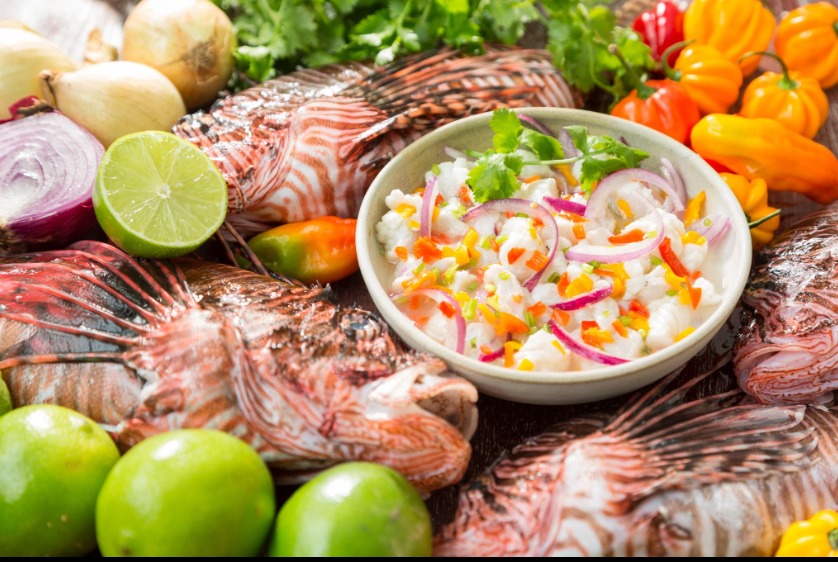
Lionfish are not only safe to eat, but delicious. The venom is contained in the spines and becomes harmless once the fish is properly handled and prepared. By choosing lionfish on the menu, divers and restaurants directly support removal efforts and help create demand for continued harvesting.
One concern often raised is ciguatera poisoning, a naturally occurring toxin found in some reef fish. Current guidance suggests that lionfish should be treated no differently than other tropical reef fish, with standard precautions and awareness in place. While there have been no confirmed cases linked specifically to lionfish, general caution is still recommended in areas where ciguatera is known to occur.
What began as an invasive species problem is now becoming part of the solution—supporting reef conservation, local fisheries, and community awareness at the same time.
What Are The Important Rules?
Safety is everything.
This is a weapon—treat it as such
Always brief divers before the dive if spearing will take place
Make sure you have a safe shot:
Ensure a clear 3-metre safety radius, confirm all divers are behind you, and remain aware of other lionfish in the area.
Protect the reef:
Maintain good buoyancy
Do not touch or damage coral or marine life
Never point a spear at anyone
If you are unsure at any point, leave the lionfish in the water. Safety always comes first.
Lionfish Net Zookeeper Hawaiian Sling
Spear Use for Divers
Spears should only be used by trained divers (Divemasters, Instructors, or those with a Lionfish Conservation Diver Specialty).
Practice using the spear on land before attempting removal underwater.
Always inform divers during the briefing that a spear will be used and explain its purpose.
Monitor your depth and air consumption (no-decompression limits recommended).
Avoid putting more than one lionfish on a spear—this is the number one cause of stings.
It is illegal to spear any other fish.
Handling & Safety

Lionfish are venomous, not poisonous.
Special Precautions: The spines of this species deliver a venomous sting that can last for days and cause extreme pain, sweating, respiratory distress, and even paralysis. The venom is delivered through grooves in the spines when they puncture the skin. It is a combination of proteins, neuromuscular toxins, and a neurotransmitter called acetylcholine (pronunciation: ah-see-toe-coe'-lean).
If you are stung by a lionfish, seek medical attention immediately.
Lionfish venom can cause:
Extreme pain
Swelling and numbness
Blisters (sometimes)
Shock (depending on the individual)
Paralysis
Necrosis
Cardiac and nervous system effects
Even after death, lionfish must be handled with care.
Venomous tissue can remain active for several hours after the fish has died
Spines can still cause envenomation if handled improperly
Contact with the spines can cause a strong reaction on the skin
The good news is that, while extremely painful, no deaths from lionfish stings have been recorded.
If You Are Stung
Treatment
Lionfish venom can be neutralised with high temperatures; therefore, it is recommended to apply hot water (45°C or as hot as you can withstand it) on the area that was stung for a period of two hours or until the pain diminishes
You can use a wet t-shirt or a cloth and heat it with the boat's engine.
Every individual reacts differently—monitor symptoms carefully and visit a Dr if necessary
After the Catch
Use a zookeeper container to store lionfish safely
Avoid stacking multiple fish on a spear
If unsure—leave the fish
If the lionfish is to be consumed:
Place it on ice
Wait at least 10 minutes until all movement has stopped before handling
Euthanisation (If Required)

Euthanisation should be carried out as soon as possible to prevent any unnecessary distress to the lionfish. The correct procedure is to make a 50ml/1.7 fluid ounces mixture: 1 part Clove Oil (5ml/0.2 fluid ounces) to 10 parts rubbing alcohol (45ml/1.5 fluid ounces).
This mixture can then be diluted with approximately 11-15 litres/3-4 gallons of seawater, and the lionfish are placed in it. This mixture must be disposed of carefully once the lionfish are euthanised.
● As the spines remain venomous up to 8 hours post death, it is important to dispose of the lionfish bodies with care to avoid accidental envenomation.
● Where the lionfish are to be consumed, they should be placed in a chest of ice and left until all apparent movement has ceased, i.e. for at least 10 minutes.
Legal & Responsible Diving
Spearfishing laws vary—always check local regulations
In many areas, Hawaiian slings are permitted only for lionfish removal
Using spears for other species may result in fines or legal action
Spearguns may be illegal in some regions
Always check local regulations
A license or certification by trained divers with appropriate lionfish removal training is strongly recommended.
Misuse of spears (e.g., targeting other fish) may result in legal action
Many regions support lionfish removal efforts—but only when conducted responsibly.
A Shared Responsibility
Long-term control depends on continued community involvement and responsible diving practices.
That means:
Respecting the reef
Following proper procedures
Educating others
Leading by example
Disclaimer
Dive centers or instructors are not responsible for injuries sustained while attempting to capture lionfish
Safety procedures must be followed at all times
If using dive center equipment, it must be returned undamaged
Activities are based on honesty, responsibility, and good judgment
Misuse of equipment should be reported immediately
What’s Next for Lionfish?
Management, Adaptation, and Opportunity.
Lionfish are unlikely to disappear from the Caribbean any time soon.
So the focus is no longer on eradication—but on management, adaptation, and opportunity.
That means:
Continued local control efforts
Stronger market demand for lionfish as food
Ongoing research and monitoring
Cooperation across all levels
It’s a long-term problem—but one where consistent, local action is already making a real difference.
Effective management relies on coordination across local, national, and international levels. Organisations such as the Aquatic Nuisance Species Task Force and NOAA’s National Marine Sanctuaries Program have developed management plans to guide response efforts in affected regions, including the Gulf and southeastern United States.
These include the National Invasive Lionfish Prevention and Management Plan (pdf, 69 pages)and the lionfish plan. Together, they focus on prevention, control, research, and collaboration—ensuring that efforts are aligned and working toward common goals.
Economic Importance
In their native Indo-Pacific range, lionfish have long been used as a food source. However, globally, they are more widely known for their role in the aquarium trade, where they remain a popular and highly sought-after species.
Ironically, that same popularity is one of the reasons they were introduced into the Atlantic in the first place.
Today, that demand is being reframed as part of the solution.
Turning a Problem into a Fishery
NOAA researcher and lionfish expert Dr James Morris hosted a lionfish symposium at the 2014 meeting of the Gulf and Caribbean Fisheries Institute in Barbados. An earlier workshop focused on harvesting invasive lionfish and found that:
Findings from workshops and symposium discussions suggest:
A commercial lionfish fishery is practical and should be encouraged
Alternative uses, such as curio products and the aquarium trade, may also provide viable markets
Local removal efforts are effective at reducing impacts—especially at smaller, community-driven scales
If reliable harvesting and distribution systems are developed, lionfish could provide an economic opportunity for small-scale fishers—while actively contributing to reef protection.
Management & Cooperation
Because lionfish are now widespread throughout the Caribbean and western Atlantic, long-term management requires cooperation between scientists, governments, dive operators, and local communities.
Current strategies focus on monitoring populations, supporting removal efforts, improving research, and slowing further spread wherever possible.
Conservation Status
In their native range, lionfish are not considered threatened or endangered.
However, like many reef species, they are still connected to the overall health of coral ecosystems. Increasing pollution and reef degradation could affect their prey base—primarily small fish and crustaceans—which may influence their populations over time.
Lionfish Beyond the Reef
Lionfish aren’t just being removed from the reef—they’re also being repurposed. Their striking fins and patterns are now being used to create unique jewellery and artisan pieces, turning an invasive species into something beautiful and meaningful. It’s another way communities can find value in an ongoing problem—one that costs nothing to receive but can help support local crafts, reduce waste, and give a second life to the fish beyond the dive.

🐟 Lionfish Fun Facts
Lionfish can eat until prey is completely depleted, not just until they’re full.
Their stomach can expand up to 30× its normal size to handle massive meals.
Females can spawn every 2–4 days in warm waters like those around Isla Mujeres.
Each spawn releases tens of thousands of eggs at a time.
That adds up to 2 million eggs per year per female.
Their eggs float in gelatinous masses and drift with ocean currents, spreading rapidly.
Lionfish have been observed herding prey together to hunt more efficiently.
They use their fan-like fins to corner prey before striking.
Lionfish can swallow prey over half their own body size.
In the Caribbean, they often hunt both day and night.
Their spines are venomous for defence, not for hunting.
They will eat almost anything that fits in their mouth.
Eating lionfish is one of the simplest ways divers can help protect reefs.
Be an AWARE Diver

Make your dives count
Use your diving skills to increase knowledge of the impacts on the marine environment
Participate in Project AWARE’s Dive Against Debris survey
Monitor coral bleaching through the Coral Watch program
Be an AWARE diver
Follow Project AWARE’S Ten Ways A Diver Can Protect The Underwater Environment and Ten Tips for Underwater Photographers
Choose to dive with operators who use moorings or drift dive techniques rather than anchors

Closing
That same reef you hovered over at the start—the one full of colour and life—is still there.
But now, you see it differently.
Lionfish are no longer just something beautiful drifting through the water. They’re part of a much bigger story—one that’s still unfolding.
And the difference is, this is one of the few times where you’re not just a visitor.
You can actually do something about it.
Reef Defender: Lionfish Management Specialty Diver
If you are doing the Pocna Dive Center Distinctive Specialty, you must complete the following exam and the final window with your personal details.
If you want to test your knowledge, have a go; it's free.
Want to experience it firsthand?
Join us in Isla Mujeres and be part of the solution. Whether it’s spotting lionfish on your dive, learning about reef conservation, or actively helping with removal efforts, every dive can make a difference.
Fisheries, N. (n.d.). Impacts of invasive lionfish. NOAA. https://www.fisheries.noaa.gov/southeast/ecosystems/impacts-invasive-lionfish
Lionfish | National Invasive Species Information Center. (n.d.). https://www.invasivespeciesinfo.gov/aquatic/fish-and-other-vertebrates/lionfish
Lionfish | Office of National Marine Sanctuaries. (n.d.). https://sanctuaries.noaa.gov/lionfish/
National Centers for Coastal Ocean Science. (2026a, January 14). Invasive Lionfish web portal supports community Management and education - NCCOS - National Centers for Coastal Ocean Science. NCCOS - National Centers for Coastal Ocean Science. https://coastalscience.noaa.gov/news/invasive-lionfish-web-portal-supports-community-management-education/
What is a lionfish? (n.d.-b). https://oceanservice.noaa.gov/facts/lionfish-facts.html
Wikipedia contributors. (2026, March 30). Lionfish. Wikipedia. https://en.wikipedia.org/wiki/Lionfish
Albins, M.A. & Hixon, M.A. (2008). Invasive Indo-Pacific lionfish reduce recruitment of Atlantic coral-reef fishes. Marine Ecology Progress Series

Tracy Gunn is the founder and former owner of Pocna Dive Center on Isla Mujeres, Mexico. A former banker turned adventurer, Tracy left a decade-long corporate career to pursue her passion for diving and island life. With over 35 years of diving experience and 24 years of living on Isla Mujeres, she now serves as a PADI Course Director, training the next generation of divers at her dive school. When she’s not underwater, Tracy shares her love for the island and the ocean through engaging blogs about diving, marine life, and the culture of Isla Mujeres.
Interested in reading more from this author?
Blogs about Isla Mujeres, Mexico, and Recreational Scuba Diving: click here
Blogs about Instructor Development Courses and Professional Scuba Diving: Click here


I was checking Lottery 7 Login online and wanted to know if the experience is the same on browser and the app. Is there any difference in speed, result updates, or features between both options?
The lionfish invasion in the Caribbean is a fascinating example of how an introduced species can disrupt marine ecosystems. Their impact on native fish and coral reefs highlights the importance of conservation, monitoring, and sustainable management. Topics like these are also valuable for authors exploring Amazon self publication and environmental issues.
This eye-opening piece perfectly balances striking lionfish facts with tangible diver-led reef solutions, and I’ll use GifToMP4 to turn its reef footage GIFs into shareable clips for ocean awareness posts. It’s refreshing to see invasive species framed as a solvable issue instead of an irreversible ecological loss.
Learning how divers safely remove invasive lionfish while turning them into food is such clever reef protection work, and kablora should highlight these hands-on marine conservation efforts for more ocean lovers to discover.
This article effectively highlights the serious threat lionfish pose to Caribbean coral reefs, underscoring the urgent need to understand and address such ecological imbalances. It makes you think about how critical it is to get accurate readings on the health of these vital ecosystems, much like using SatSpeedCheck to monitor system performance.